Reference
Dating a postcard by its stamp
A stamp gives you one thing reliably: a card cannot have been mailed before the stamp was issued. That makes the stamp a hard floor under any date — but never a ceiling, because stamps stayed on sale, and in desk drawers, for years. Find your denomination below, match the portrait or scene to the right stamp, and take its issue date as the earliest possible mailing.
Stamps are grouped by face value, since that is what you can read at a glance. Under each you will find the everyday definitives and, where we have them, commemoratives — which were issued for a single occasion and so pin a date down more tightly. Every stamp is one from a card in our own collection; where the card is postmarked, we note the date, because it checks the identification (and, for the 1¢ Franklin, corrects it). We describe stamps by name, denomination, colour, series and issue year, never by catalogue number.
One cent 1¢
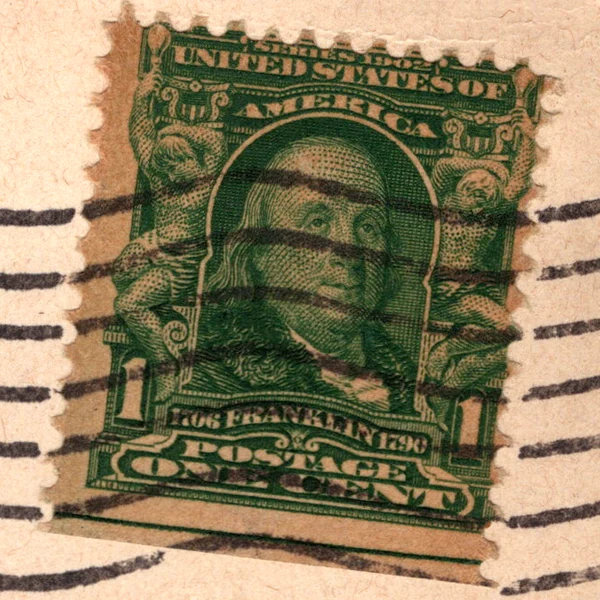 On a card in our collection postmarked Ocean City, N. J., 6:30 AM on September 1, 1908 — shown in full on the postmarks page. That readable date is what rules out the later Washington–Franklin printing and fixes this as the Series of 1902 stamp.
Benjamin FranklinDefinitive
A card bearing this stamp was mailed in or after February 1903.
This is the case where the postmark rewrites the answer. The 1¢ green Franklin appears in two different series that look alike at a glance: the Series of 1902 (this one) and the Washington–Franklin series that followed. But the first Washington–Franklin stamp of any value was not released until November 16, 1908, and its 1¢ Franklin not until December 1908. Our card is postmarked September 1908 — before either existed — so it must be the earlier Series of 1902 stamp, no watermark soaking required.
The wider lesson: within the Washington–Franklins of 1908–1922, the same design was printed with different watermarks, perforations and presses, and telling those apart needs a perforation gauge and watermark fluid, not a scan. When a design spans years, reach for the postmark before the magnifier.
Sources: 1¢ Franklin of the Series of 1902 first issued February 3, 1903, and the ‘Series 1902’ year-date feature was dropped when the Washington–Franklin series began in 1908: Smithsonian National Postal Museum, Second Bureau Issues; First Washington–Franklin stamp (2¢) issued November 16, 1908; 1¢ Franklin (Washington–Franklin) issued December 1908: Smithsonian National Postal Museum; Mystic Stamp Company.
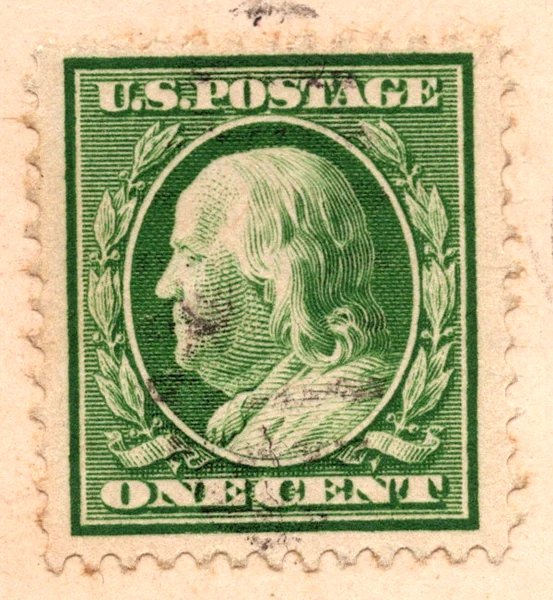 On a card in our collection postmarked 1911 — which places it in the Washington–Franklin period, not the earlier Series of 1902.
Benjamin FranklinDefinitive
A card bearing this stamp was mailed in or after 1908; this example is postmarked 1911.
This is the other 1¢ green Franklin — the Washington–Franklin design that replaced the Series of 1902 shown above. From a normal scan the two are easy to confuse; the giveaway here is the postmark (1911, so it cannot be the pre-1908 series) and the single-line design. And this Franklin belongs only to 1908–1911: in 1912 Washington took over the 1¢ value (see the 1¢ Washington below), so the portrait itself dates the card to the first half of the era.
A caution worth taking seriously: within the Washington–Franklins the same face design was printed for fourteen years across flat-plate and rotary presses, several perforation gauges, and two watermarks — producing dozens of catalogue varieties, a few of them genuinely valuable. Which one you hold cannot be told from a scan; it needs a perforation gauge and watermark fluid. If a 1¢ green Franklin of this era matters to you, have it measured before pricing.
Sources: Washington–Franklin series 1¢ Franklin, design in production 1908–1922, printed across multiple perforations and watermarks: Smithsonian National Postal Museum; Mystic Stamp Company.
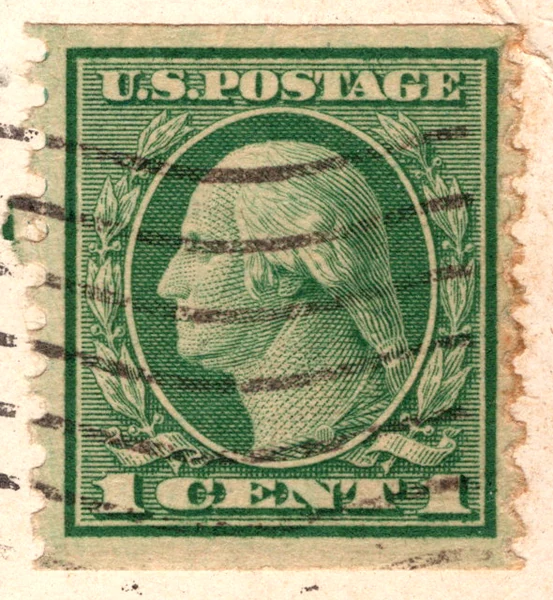 On a card in our collection; the perf-12 gauge places the stamp in 1912–1914.
George WashingtonDefinitive
A card bearing this stamp was mailed in or after 1912.
Here the portrait itself is the dating clue. The 1¢ green stamp shows Franklin in 1908–1911 (above) but Washington from 1912, when the design was redrawn with the value in numerals — “1 CENT 1” — instead of the spelled-out “ONE CENT.” So a 1¢ green Washington cannot predate 1912, and the two portraits neatly split the Washington–Franklin era in half.
The same caution as its Franklin sibling, only more so: the 1¢ Washington ran through some thirty renditions between 1912 and 1922 — flat-plate and rotary printings, several perforation gauges, different watermarks — a few of them genuinely valuable. None can be told from a scan; it takes a perforation gauge and watermark fluid. And here that pays off: ours measures perf 12 on the side, the gauge of the 1912–1914 printings, before the change to perf 10 in 1914 — so on this card the perforation genuinely narrows the stamp to the first years of the Washington 1¢.
Sources: Washington–Franklin 1¢: Franklin 1908–1911, then Washington from 1912 (design redrawn with numerals), running to 1922 across ~30 renditions: Smithsonian National Postal Museum; Mystic Stamp Company; Wikipedia (Washington–Franklin Issues).
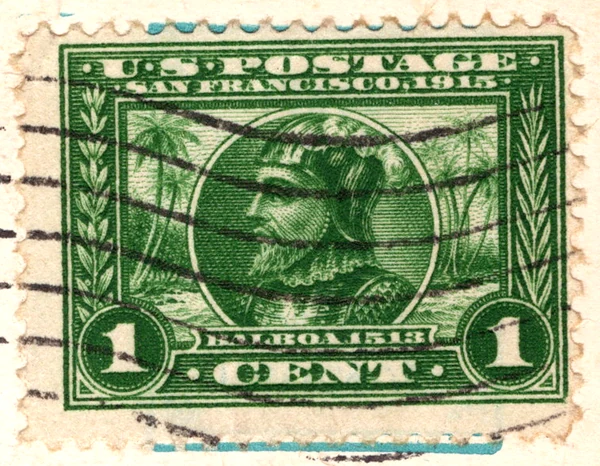 On a card in our collection postmarked July 1914.
Vasco Núñez de BalboaCommemorative
A card bearing this stamp was mailed in or after 1913.
A commemorative that belongs on a postcard: the 1¢ Balboa paid the postcard rate, so it rode a great many cards of the mid-1910s. It marks the 400th anniversary of Balboa’s 1513 sighting of the Pacific, and publicized the 1915 Panama-Pacific Exposition in San Francisco — all four designs were inscribed “San Francisco 1915” though sold from 1913.
The perforation dates the printing: perf 12 is the 1913 issue, perf 10 the December 1914 reissue. Our example is postmarked July 1914.
Sources: 1¢ Panama-Pacific Exposition (Balboa), issued January 1, 1913; paid the postcard rate; perf 12 (1913) vs perf 10 (Dec 1914): Smithsonian National Postal Museum; Mystic Stamp Company.
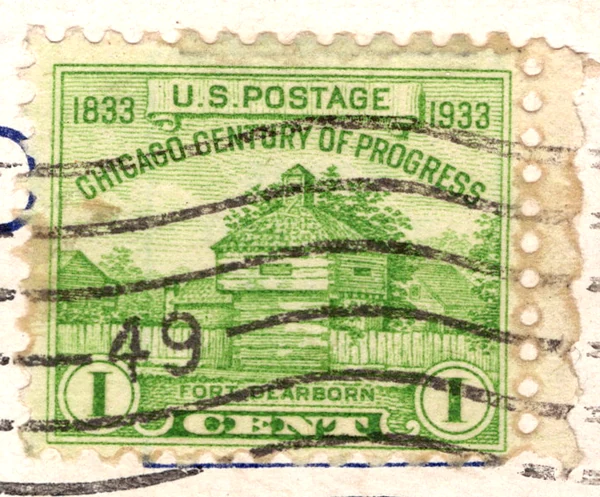 On a card in our collection postmarked July 1933 — during the fair itself.
Fort DearbornCommemorative
A card bearing this stamp was mailed in or after 1933.
Issued for Chicago’s 1933 world’s fair, “A Century of Progress,” and marking the city’s 1833–1933 centennial. It pictures Fort Dearborn, the frontier fort of 1833. A cheap commemorative that saw heavy postcard use during the fair.
Sources: 1¢ Century of Progress (Fort Dearborn), issued 1933 for the Chicago world’s fair: Smithsonian National Postal Museum; Mystic Stamp Company.
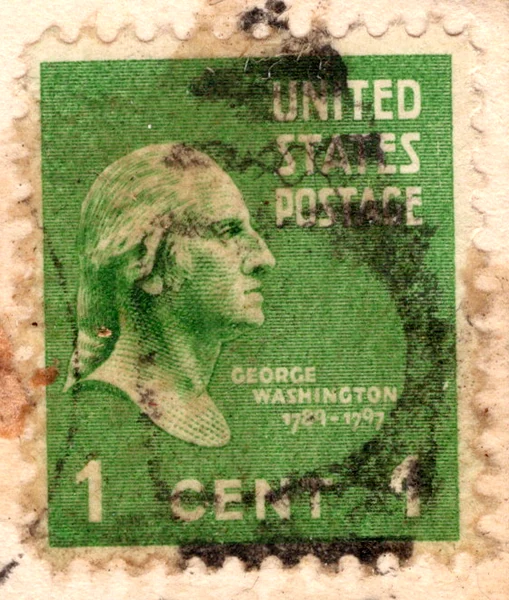 On a card in our collection postmarked August 1947 — nine years after the stamp was issued.
George WashingtonDefinitive
A card bearing this stamp was mailed in or after April 1938.
The 1¢ value of the Prexies, and the first stamp of that series issued. In a break with tradition it put Washington on the 1¢ postcard-rate stamp — the slot Franklin had usually held — and moved Franklin down to the half-cent.
Our example is postmarked August 1947, nine years after issue: a clean reminder that a definitive gives you a floor, not the date.
Sources: 1¢ Washington, Presidential series, issued April 25, 1938, Washington D.C., the first Prexie issued: Mystic Stamp Company; Smithsonian National Postal Museum.
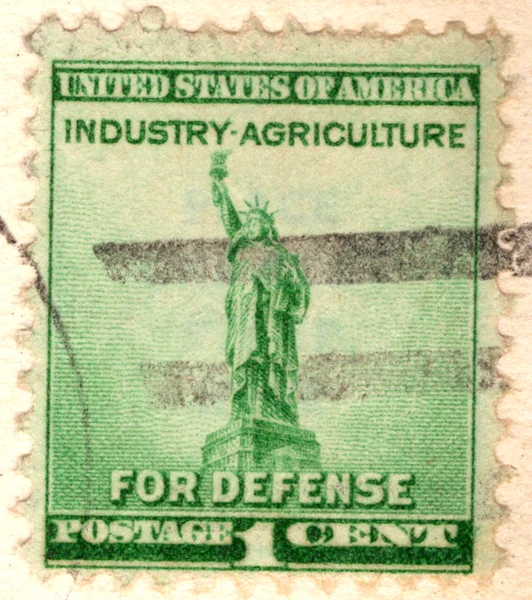 On a card in our collection postmarked between 1941 and 1943.
Statue of Liberty (National Defense)Commemorative
A card bearing this stamp was mailed in or after 1940.
A propaganda issue of the eve of war: the 1¢ of the three-stamp National Defense set, reading “Industry Agriculture” above the Statue of Liberty and “For Defense” below. It went on sale October 16, 1940 — the first day of registration for America’s first peacetime draft. The Post Office asked postmasters to sell these instead of the regular 1¢ Prexie Washington, so for a few wartime years this is the everyday 1¢. Ours is postmarked 1941–1943.
Sources: 1¢ Statue of Liberty, National Defense issue, issued October 16, 1940 (with the 2¢ anti-aircraft gun and 3¢ torch): Smithsonian National Postal Museum; Mystic Stamp Company.
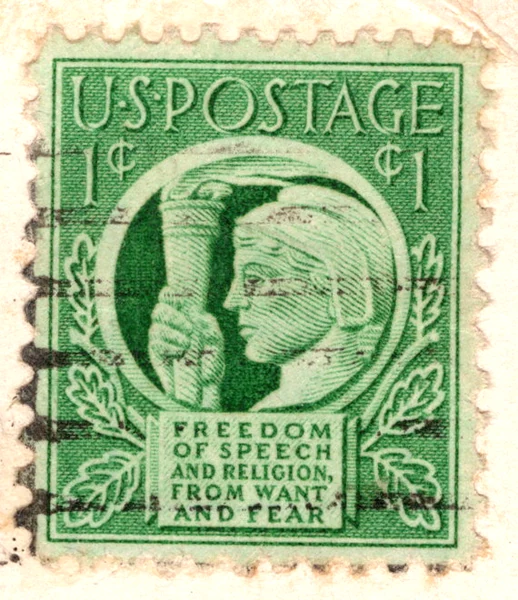 On a card in our collection postmarked July 1945.
The Four FreedomsCommemorative
A card bearing this stamp was mailed in or after 1943.
A wartime stamp drawn from Franklin Roosevelt’s 1941 “Four Freedoms” address — freedom of speech and of religion, freedom from want and from fear. A 1¢ rallying issue of the home front.
Sources: 1¢ Four Freedoms, issued 1943, from FDR’s 1941 address: Smithsonian National Postal Museum; Mystic Stamp Company.
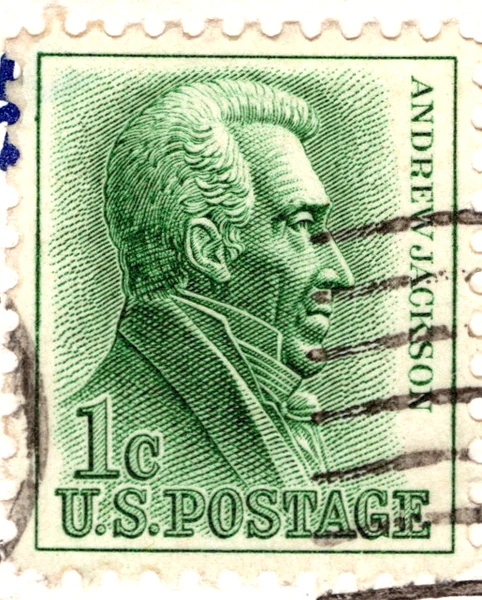
Andrew JacksonDefinitive
A card bearing this stamp was mailed in or after 1963.
The 1¢ green Jackson of the early-1960s regular issues (the series just before the Prominent Americans). By this period the 1¢ stamp was rarely a whole postcard rate on its own — more often it made up part of a larger rate — so on a card it usually rode alongside other postage.
Sources: 1¢ Andrew Jackson, green, issued 1963: Mystic Stamp Company (first-day covers dated 1963).
Two cents 2¢
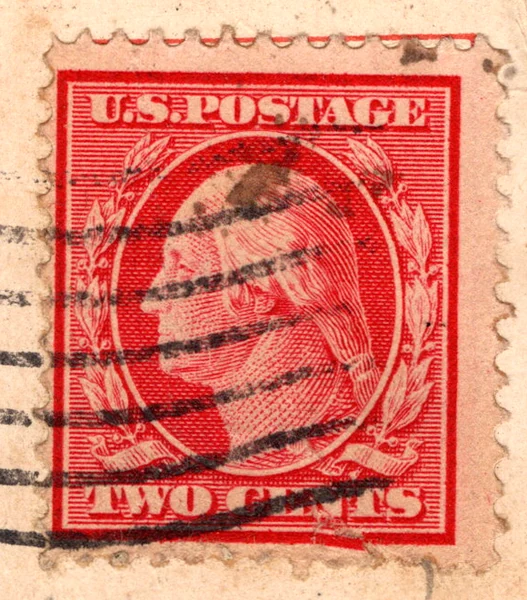 On a card in our collection postmarked 1911.
George WashingtonDefinitive
A card bearing this stamp was mailed in or after 1908; this example is postmarked 1911.
The 2¢ carmine Washington was the workhorse letter stamp of its day, so it turns up constantly on early-1910s mail. The same perforation-and-watermark caution as the 1¢ Franklin applies here in full — the 2¢ Washington is one of the most variety-rich stamps in US philately, and the differences don’t show in a scan.
Postmarked 1911, so 1908–1911; the exact printing needs a gauge and watermark check.
Sources: Washington–Franklin series 2¢ Washington, carmine, design in production 1908–1922 across many perforations and watermarks: Smithsonian National Postal Museum; Mystic Stamp Company.
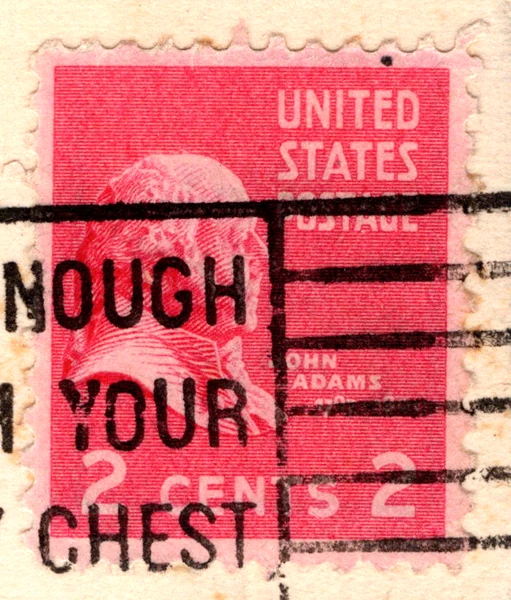 On a card in our collection postmarked November 16, 1951, with a Community Chest slogan cancel.
John AdamsDefinitive
A card bearing this stamp was mailed in or after June 1938.
The 2¢ Prexie’s natural home was the postcard: it became the everyday postcard workhorse when the domestic postcard rate rose to 2¢ on January 1, 1952.
Our example is postmarked November 16, 1951 — about six weeks before that rate change — so the 2¢ here slightly overpaid the 1¢ postcard rate still in force. A small thing, but it is the postage rate cross-examining the postmark, and both agree the card is late 1951.
This one card earns its keep three times: its cancel is the Community Chest slogan on the postmarks page, and it was printed by Colourpicture of Boston — see the Colourpicture entry.
Sources: 2¢ John Adams, Presidential series, rose carmine, issued June 3, 1938, Washington D.C.: Smithsonian National Postal Museum; Mystic Stamp Company; Domestic postcard rate 1¢ until January 1, 1952, then 2¢: Smithsonian National Postal Museum, U.S. Domestic Postcard Rates.
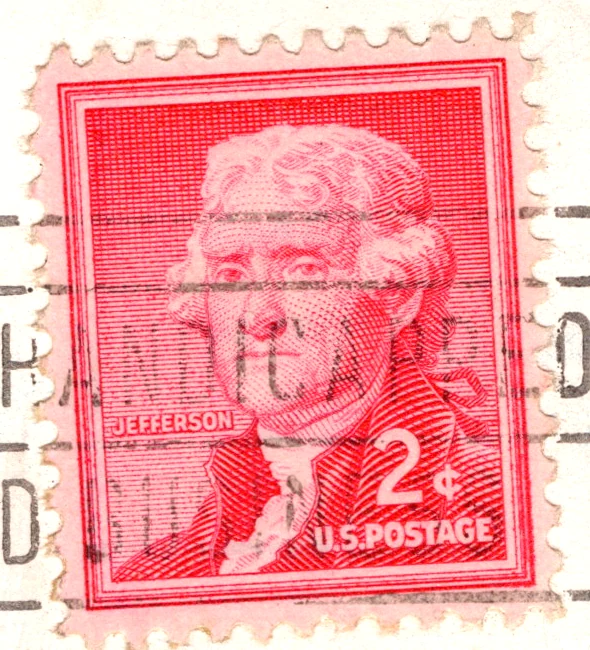
Thomas JeffersonDefinitive
A card bearing this stamp was mailed in or after September 1954.
Issued to cover the 2¢ postcard rate, so it turns up constantly on mid-1950s cards.
The Liberty series ran from 1954 and was largely replaced by the Prominent Americans series from 1965 — but the 2¢ value was reprinted as a coil and sold well into the 1980s, so it is a weak upper bound.
Sources: Liberty series 2¢ Jefferson, first day September 15, 1954: Mystic Stamp Company.
Three cents 3¢
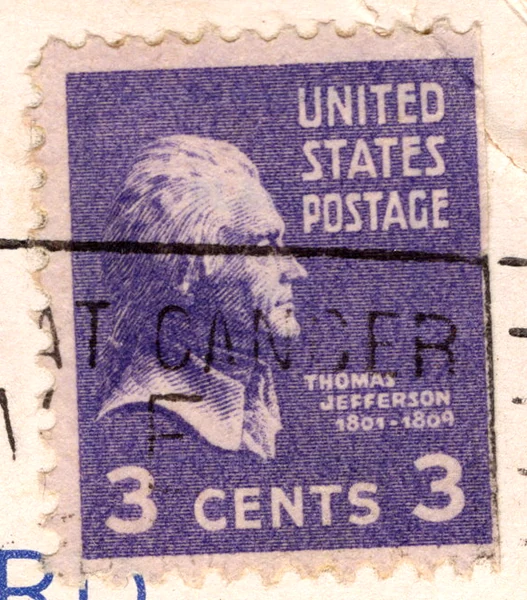 On a card in our collection postmarked 1954.
Thomas JeffersonDefinitive
A card bearing this stamp was mailed in or after June 1938.
The 3¢ Prexie carried the first-class letter rate of its era, so it is extremely common — and it is Jefferson, not Washington, in another of the series’ breaks with tradition. On a postcard it usually means the card travelled at letter rate or the sender overpaid.
Distinct from the 3¢ Statue of Liberty below: that one is the 1954 Liberty issue, this is the 1938 Presidential issue. Our example is postmarked 1954, still comfortably within its long run.
Sources: 3¢ Jefferson, Presidential series, issued June 16, 1938: Smithsonian National Postal Museum; Mystic Stamp Company.
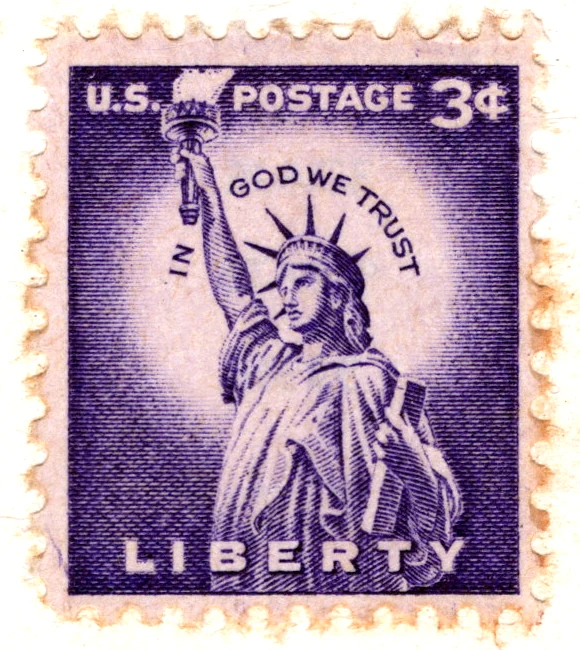
Statue of LibertyDefinitive
A card bearing this stamp was mailed in or after June 1954.
The 3¢ value covered the first-class letter rate; on a postcard it usually means the sender overpaid, or the card travelled at letter rate.
The first definitive in this series to carry the motto “In God We Trust,” and unusual in showing the Statue of Liberty rather than a president.
Sources: Liberty series 3¢ Statue of Liberty, issued June 24, 1954, Albany NY: Mystic Stamp Company.
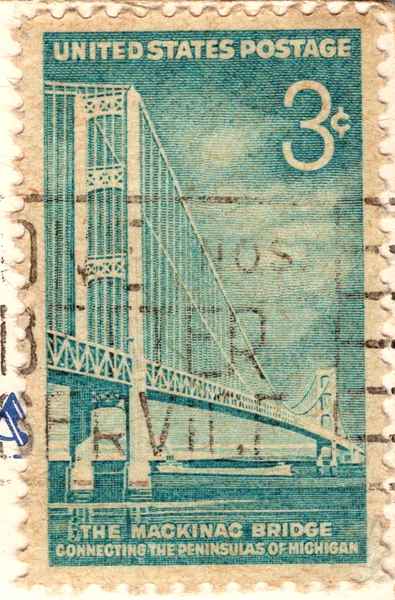 On a card in our collection postmarked 1958 — the same year as issue, which is typical for a commemorative.
Mackinac BridgeCommemorative
A card bearing this stamp was mailed in or after June 1958.
A commemorative, not a workhorse definitive — issued for a single occasion (the bridge opened in 1957) rather than as everyday postage, so it dates a card more tightly than a long-running definitive does.
Commemoratives are generally used within a year or two of issue, which makes them useful: a 1958 commemorative on a card is strong evidence for a late-1950s mailing.
Sources: 3¢ Mackinac Bridge commemorative, issued June 25, 1958, Mackinac Bridge, Michigan: Mystic Stamp Company.
Four cents 4¢
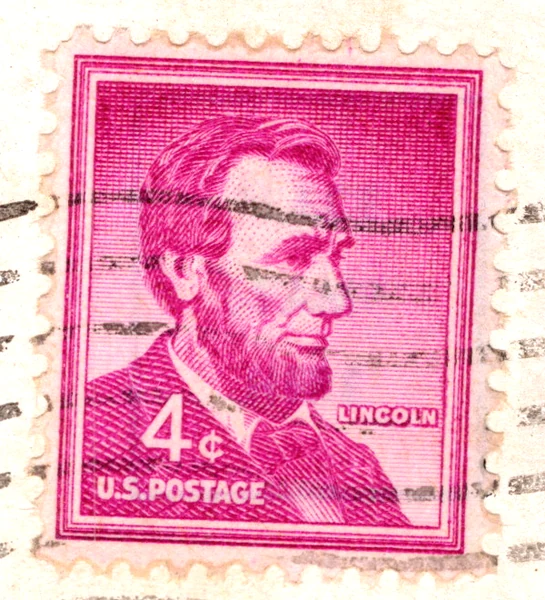 On a card in our collection postmarked July 1964 — comfortably after the 1954 issue and inside the stamp’s workhorse years.
Abraham LincolnDefinitive
A card bearing this stamp was mailed in or after November 1954.
When first-class postage rose from three cents to four on August 1, 1958, this became the most heavily used stamp in the country, so it is extremely common on cards from 1958 through the early 1960s.
Sources give the first-day date as either 16 or November 19, 1954; we cite the range rather than pick one. Either way the bound is November 1954.
Sources: 4¢ Lincoln, Liberty series, red violet, issued November 1954 (Mystic gives 19 November; the Smithsonian National Postal Museum gives 16 November); became the first-class workhorse after the August 1, 1958 rate rise: Mystic Stamp Company; Smithsonian National Postal Museum.
Five cents 5¢
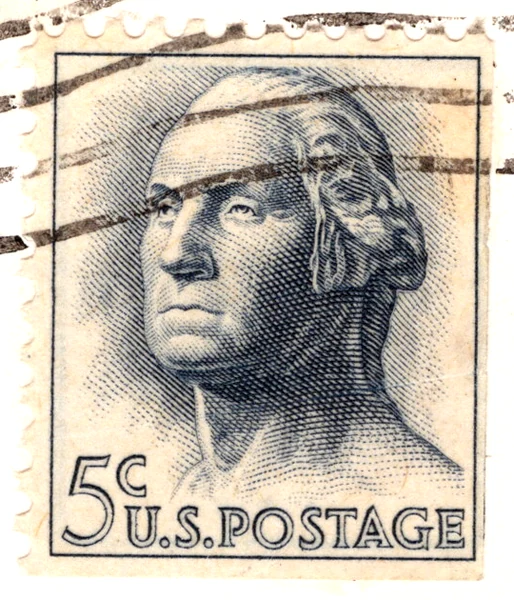 On a card in our collection postmarked 1970.
George WashingtonDefinitive
A card bearing this stamp was mailed in or after the mid-1960s; this example is postmarked 1970.
Two look-alike 5¢ Washington definitives circulated in this era — one from 1962, and the 1966 Prominent Americans value (nicknamed the “dirty face” Washington for its heavy shading, and redrawn cleaner in 1967). Telling them apart takes a close look at the portrait; either way the stamp comfortably predates this card’s 1970 postmark.
By the later 1960s the 5¢ rate had moved on, so on a 1970 card this stamp is usually part of a made-up rate rather than the whole postage.
Sources: 5¢ George Washington, Prominent Americans series, issued February 22, 1966 (redrawn 1967); a separate 5¢ Washington definitive was issued 1962: Mystic Stamp Company; Wikipedia (Prominent Americans series).
Six cents 6¢
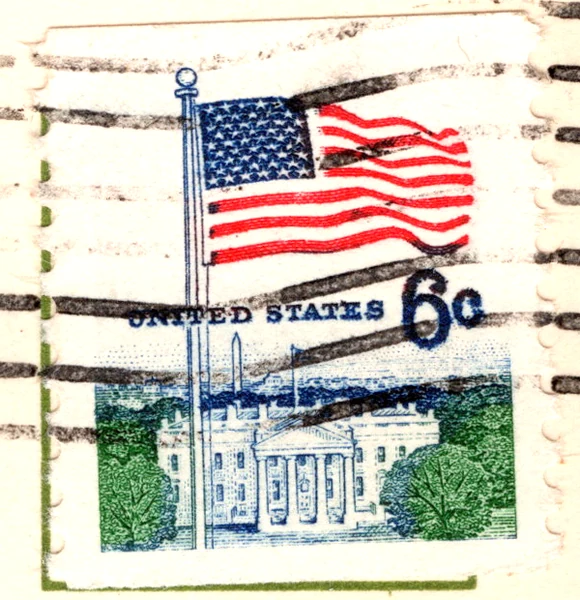 On a card in our collection postmarked June 1971.
Flag over the White HouseDefinitive
A card bearing this stamp was mailed in or after 1968.
The workhorse flag-over-White-House definitive of the late 1960s, from the era when first-class postage was six cents. Common on everyday mail of 1968–1971.
Sources: 6¢ Flag over the White House, issued 1968: Smithsonian National Postal Museum; Mystic Stamp Company.
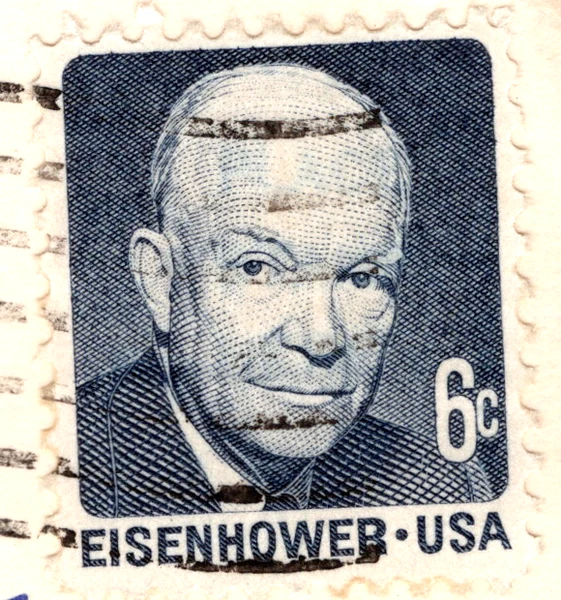 On a card in our collection postmarked in the 1970s.
Dwight D. EisenhowerDefinitive
A card bearing this stamp was mailed in or after 1970.
Issued when the first-class rate rose to six cents, this Eisenhower replaced the 6¢ Franklin D. Roosevelt in the Prominent Americans series (the same Eisenhower portrait was later reissued at 8¢ when the rate rose again). A useful late floor: a 6¢ Eisenhower rules out everything before 1970.
Sources: 6¢ Eisenhower, Prominent Americans series, issued 1970, replacing the 6¢ Franklin D. Roosevelt when the first-class rate rose to 6¢: Smithsonian National Postal Museum; Mystic Stamp Company.
Seven cents (airmail) 7¢
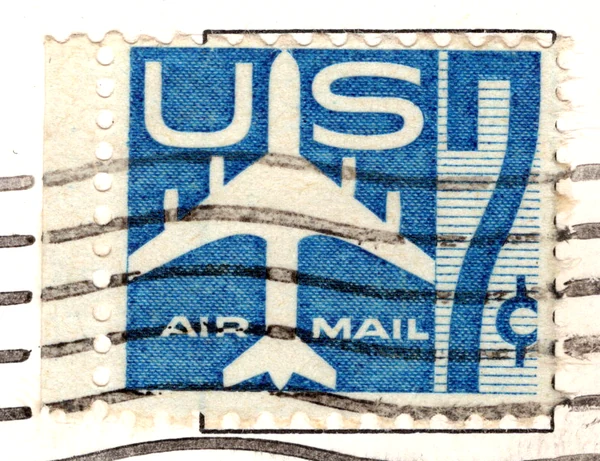 On a card in our collection postmarked 21 November 1960, mailed San Clemente to Seattle by air.
Silhouette of a Jet AirlinerAirmail
A card bearing this stamp was mailed in or after August 1958.
An airmail stamp, not ordinary postage: in 1958 a 7¢ airmail stamp bought a letter a seat on a plane, while ordinary first-class mail still travelled by train and truck. The separate domestic airmail rate was phased out in the mid-1970s, after which first-class mail simply flew when that was faster.
The colour dates the printing, and this one is the original sky-blue of 1958 — a shade so often missed by mail sorters that the Postmaster General ordered airmail stamps reprinted in “fire red” in 1960. Blue is 1958; red is 1960.
Sources: 7¢ Silhouette of Jet Airliner airmail, issued blue 31 July 1958 and reissued red (“fire red”) 1960 for sorter visibility; 7¢ airmail rate effective 1 August 1958: Smithsonian National Postal Museum; Mystic Stamp Company.
Eight cents 8¢
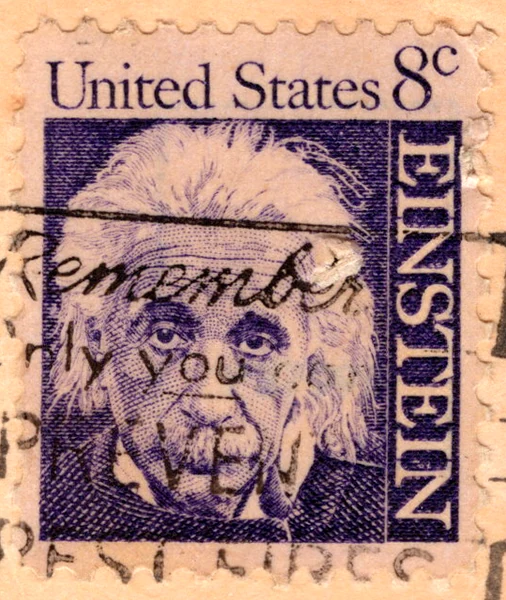 On a card in our collection postmarked August 1971.
Albert EinsteinDefinitive
A card bearing this stamp was mailed in or after 1966.
Einstein held the 8¢ value of the Prominent Americans series until Dwight Eisenhower replaced him there when first-class postage rose to 8¢ in 1971. So an 8¢ Einstein in use is a stamp of 1966–1971. Ours is postmarked August 1971, near the end of that window.
Sources: 8¢ Albert Einstein, Prominent Americans series, issued March 14, 1966; later replaced at 8¢ by Eisenhower in 1971: Smithsonian National Postal Museum; Mystic Stamp Company.
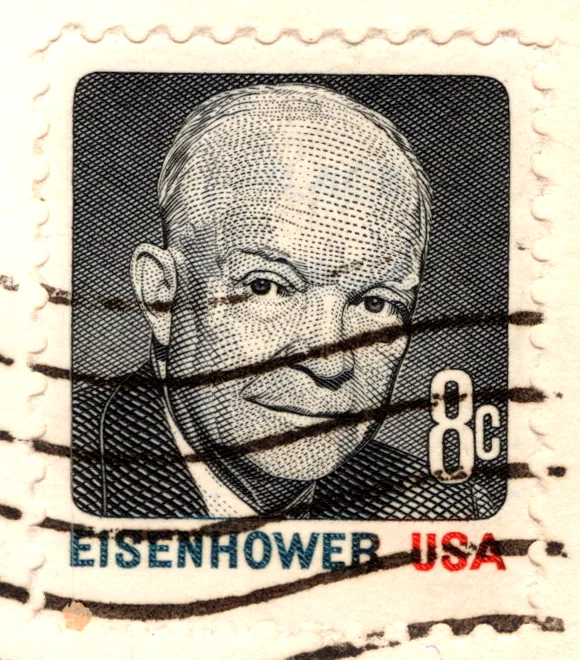
Dwight D. EisenhowerDefinitive
A card bearing this stamp was mailed in or after May 1971.
Issued in sheet, coil and booklet form on the same day; a 6¢ Eisenhower of similar design came first.
A useful late bound: an Eisenhower 8¢ rules out the whole linen era and most of the early chrome era.
Sources: 8¢ Eisenhower first day May 10, 1971, Washington D.C.: US Postal Service records; Mystic Stamp Company.
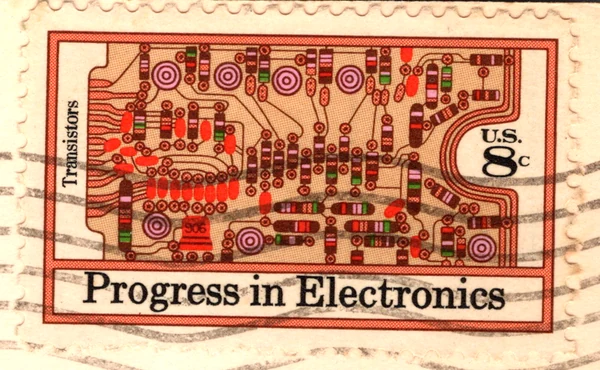 On a card in our collection postmarked 1978 — fully five years after issue, a live example of a stamp lingering long after its release.
Progress in Electronics: Transistors and Printed CircuitCommemorative
A card bearing this stamp was mailed in or after July 1973.
Part of a four-stamp “Progress in Electronics” set (6¢, 8¢, 11¢ airmail and 15¢); the 8¢ shows a transistor and printed circuit, marking Bell Labs’ 1948 invention of the transistor.
A clean demonstration of why a stamp is only a floor: our card is postmarked 1978, five years after the stamp was issued. The stamp says “not before July 1973”; the postmark says the actual mailing was 1978.
Sources: “Progress in Electronics” set issued July 10, 1973; the 8¢ value depicts transistors and printed circuit (Bell Labs transistor, 1948): Mystic Stamp Company; Smithsonian/Calisphere records.
Eighteen cents (the “B” rate) 18¢
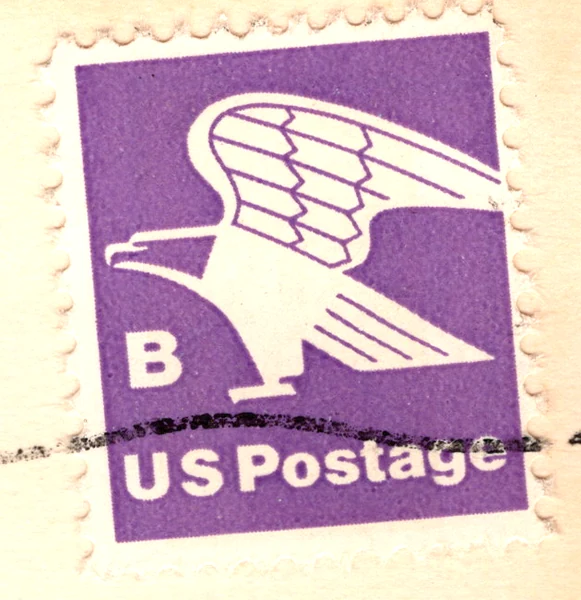 On a card in our collection from 1981.
The non-denominated “B” EagleDefinitive
A card bearing this stamp was mailed in or after 1981.
A stamp with no number on it. From 1975 the Post Office printed non-denominated stamps ahead of time, to have postage ready the moment a rate rose but before the exact new rate was set. This is the “B” stamp — a stylized eagle, printed after the 1978 increase and held in storage until needed. When first-class went from 15¢ to 18¢ in March 1981, it was released; “B” means 18¢.
The letter dates it precisely: A = 15¢ (1978), B = 18¢ (1981), C = 20¢ (1981), D = 22¢ (1985). The B and the earlier A share the same eagle; the B is violet where the A was orange.
Sources: Non-denominated “B” Eagle = 18¢, issued March 15, 1981 (rate rose 15¢→18¢ on March 22, 1981); US non-denominated postage began 1975: Smithsonian National Postal Museum; Mystic Stamp Company.
Twenty-one cents (airmail) 21¢
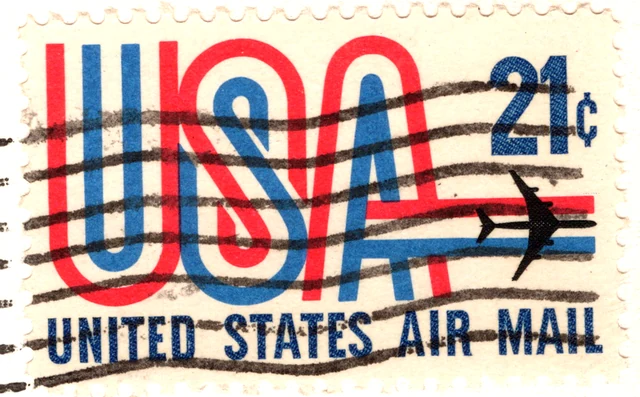 On a card in our collection from 1979.
USA and JetAirmail
A card bearing this stamp was mailed in or after 1971.
An international airmail stamp: the 21¢ rate flew a half-ounce letter to most of the world — everywhere except North and South America — from 1971. On a card, it usually means overseas airmail. Ours is on a 1979 card.
Sources: 21¢ USA and Jet airmail, issued May 21, 1971 for the international airmail rate increase to 21¢ per half-ounce: Smithsonian National Postal Museum; Mystic Stamp Company.
Two companion clues: postage rates have their own tool, the postage-rate lookup, and the marking struck over the stamp is often the sharpest evidence on the card — see postmarks and cancels.